What an applicant tracking system does, and how to pick one.
An applicant tracking system (ATS) is software that collects job applications and keeps each candidate's stage, messages, interview feedback, and offer on one shared record. A small business should judge one on what happens to a single real application, and on what the price leaves out. Join's Advanced trial runs 14 days; Standard then costs €20 per active job each month.
Whatever the feature list says, a weak spot in an applicant tracking system shows up the same way: work drifts back into email.
Collect applications
Every application lands on the right job with its source, CV, and history, whether it came from a job board or the careers page, or was added by hand.
Screen against the job
Questions on the application form settle the hard requirements, so reviewers read the candidates who meet them.
Coordinate the team
Interviews, messages, notes, and scorecards sit on the candidate record, visible to the people with access to that job.
Keep a defensible record
Who decided what, on which evidence, and how long the data stays: the record answers that when a candidate or a colleague asks.
HOW TO CHOOSE AN ATS
Run one real application through each tool.
A useful comparison follows one application from its source to the final decision. For a small business it also shows who pays for access, how long the contract runs, and what the advertised price leaves out.
Question to ask
What to verify
How Join handles it
Application intake
Where do applications arrive?
One current record rather than copied entries
The application enters the pipeline for its job
Is the source retained?
The original board or careers page stays identifiable
The source is attached to the application
Can we publish from the same tool?
Job distribution is connected to candidate tracking
Organic distribution uses the compatible boards available from a 10+ network; paid boards are optional
Selection and control
How are candidates compared?
The same requirements and evidence for each person
Screening questions and shared scorecards
Where does communication live?
Messages remain connected to the candidate
Templates, sends, and history on the candidate profile
Who can see the record?
Access follows each person's hiring role
Job-level roles and permissions
How is candidate data handled?
Export, retention, and deletion can be carried out
Consent status, export, redaction, and erasure tools
Cost for a small team
What is the price based on?
Per user, per job, or a yearly licence, and what each model charges for an extra reviewer
Per active job each month; users and candidates are unlimited
How is it billed?
Monthly or annual, and what the annual price commits you to
Monthly or annual billing; annual works out two months cheaper
FROM SPREADSHEET TO ATS
Moving candidate tracking out of Excel
A spreadsheet stays workable while one person hires occasionally. You don't need to move the whole file. Bring over the jobs and candidates still in play, prove the setup on one vacancy, then retire the spreadsheet.
1
Keep only the live records
Take the open jobs and the candidates still in a process. Do not carry over duplicates or records you have no reason to retain; delete them under your retention policy.
2
Agree on short stages
New, screening, interview, offer, hired, and rejected is often enough. Do not rebuild every old column as a pipeline stage.
3
Add the live candidates to their jobs
Add each remaining candidate to the right job with "Add application", with the source recorded. Join emails every manually added candidate a GDPR consent request, so tell them the move is coming.
4
Run one job end to end
Put one active vacancy through Join first and check intake, messages, feedback, and reporting. Keep the spreadsheet read-only until the new record has proved itself.
JOIN AT A GLANCE
Start with the full workflow. Keep the cost tied to active hiring.
14 days
Advanced trial with no credit card
Up to 5
active jobs during the trial
10+
organic boards in the distribution network
€20
per active job each month on Standard
01 · COLLECT
The job ad and its applications stay connected.
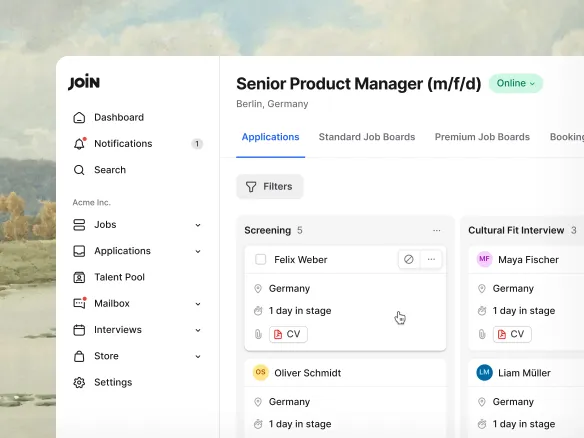
Create the job ad in Join and publish it once. Join distributes it to the compatible organic boards available for the job from a network of more than 10. You can add paid regional or specialist reach separately. Every incoming application is assigned to the job pipeline with its source, CV, and activity on the same record.
One job record for publication status and applications
A structured candidate profile built from the CV
The acquisition source attached to each application
Manual adds for candidates who applied outside Join, source included
02 · DECIDE
Define the evidence before the interview.
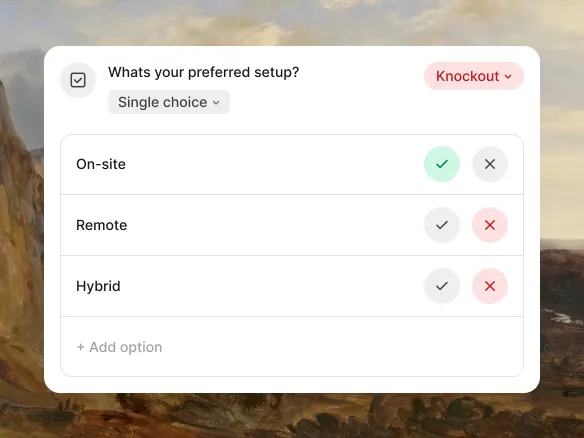
Use screening questions for requirements that genuinely decide whether someone can do the job. Prepare a scorecard before interviews begin, ask the same core questions, and keep each review on the candidate profile. The team can see where assessments agree and where another conversation is needed.
Screening questions tied to the job requirements
Shared scorecards using the same criteria and scale
Interview scheduling connected to the candidate record
03 · SPEED
Cut the waiting between steps.
Much of a slow hire is waiting: a job ad waiting to be posted board by board, a stack of CVs nobody has opened, and a week of "does Tuesday work?" emails. On the 8 boards that support Quick Apply, candidates apply in one click without leaving the board; customers see up to 3x more applications per board than with a standard click-through ad. Candidates then book an interview themselves from the free slots in the interviewers' connected Google or Outlook calendars. The interviews and the decision stay with your team.
Knockout questions settle must-haves when the candidate applies
Self-booking from live calendar availability, with reschedule and cancel links
04 · FOLLOW THROUGH
Keep the decision and the conversation together.
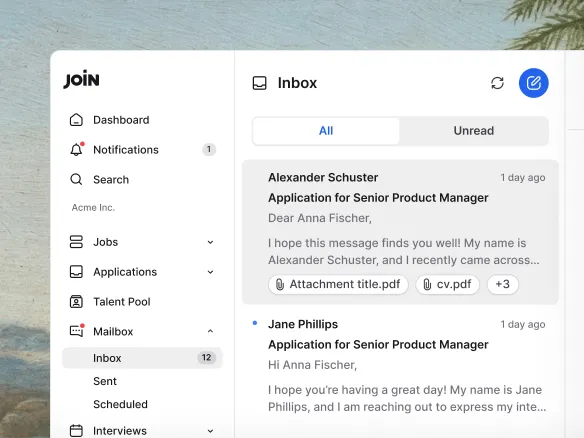
Candidate messages, internal notes, interview details, and the offer remain on the same profile. Automations can send selected updates, add tags, or move an application after a defined trigger. The hiring team still owns the assessment and final decision.
A shared communication history for authorised reviewers
Automations limited to the administrative steps you define
An applicant tracking system (ATS) is software that keeps applications, candidate records, hiring stages, messages, interviews, evaluations, and offers together. It gives authorised reviewers one current record for each candidate and job instead of splitting the process across job boards, email, calendars, and spreadsheets.
Is ATS software the same as recruiting software?
Mostly. Recruiting software is the wider label and can include sourcing tools, careers pages, and onboarding. The applicant tracking system is the core of it: the pipeline where the team follows each application to a decision. Join puts job advertising, the careers page, and the ATS in one product.
What is the difference between an ATS and an HRIS?
An ATS manages the work before a person is hired: advertising the job, receiving applications, assessing candidates, arranging interviews, and recording the offer. A human resources information system (HRIS) primarily manages employee data and post-hire processes such as payroll, absence, time, and performance. Some suites combine both. Join concentrates on recruitment and can sit alongside an existing HRIS.
When does a small business need an ATS?
An ATS becomes useful when applications arrive from several sources, another person joins the decision, follow-ups depend on memory, or candidate information is copied between email and a spreadsheet. A business making one occasional hire with a single reviewer may not need a large system. Start with the smallest workflow that gives the team one reliable record.
Is Join designed for small and mid-sized businesses?
Yes. Join combines job advertising and candidate tracking, charges per active job rather than per user, and supports unlimited users and candidates. That model suits an in-house team whose hiring volume changes during the year. More than 20,000 teams use Join.
Does Join offer a free applicant tracking system?
Join does not offer a permanently free ATS plan. The Advanced trial lasts 14 days, includes up to five active jobs, requires no credit card, and ends automatically. You pay only if you choose a paid plan after the trial.
How much does Join's ATS cost?
Standard starts at €20 per active job each month after the trial. Users and candidates are unlimited. Organic distribution is included, and paid job-board placements are an optional extra. The pricing page sets Standard, Advanced, and Enterprise side by side.
Can I advertise jobs and track candidates in the same system?
Yes. Join connects its job advertising software with the ATS. A published job, its board status, application sources, and candidate pipeline remain linked. Organic distribution uses the compatible boards available for the job from a network of more than 10; more than 250 paid boards are available separately.
Does hiring faster with an ATS mean weaker hires?
It should not. The time an ATS saves comes from removing waiting between steps: posting, a CV backlog, interview scheduling, a forgotten reply. Requirements, interviews, and the decision stay as rigorous as your team makes them, and shared scorecards keep the evaluation consistent from one candidate to the next.
Can an ATS make recruitment GDPR compliant?
No system makes an employer compliant on its own. The organisation remains responsible for its lawful basis, notices, access policy, retention schedule, and candidate requests. The UK Information Commissioner's Office explains that recruitment data protection runs from advertising through deletion in its recruitment and selection guidance. A spreadsheet is not unlawful by itself either: what matters is how access, retention, and deletion are controlled. Join provides permissions, consent status, export, redaction, and erasure tools. Its ISO 27001:2022 certification and subprocessors are published at trust.join.com.
Can I move existing candidates into Join?
Yes. Add candidates who are still in a live process to their job with "Add application", with name, email, source, and CV; Join then sends each of them a GDPR consent request. Delete duplicates and records you no longer need under your retention policy. The spreadsheet migration steps above cover stages and a one-job test before a wider move.
Start today
Start your 14-day free trial and make hiring your advantage.