The right access for every role on the hiring team.
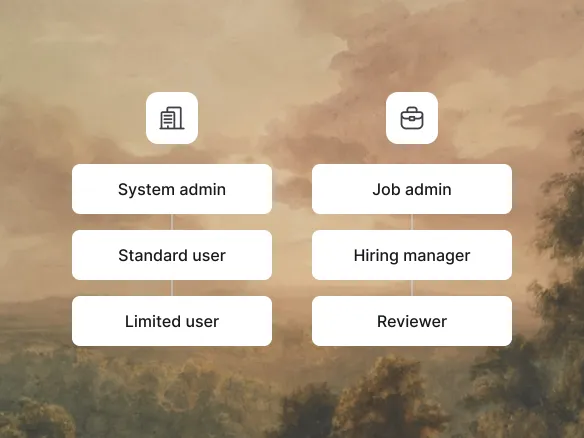
A two-tier role model: three company-wide roles and three per-job roles. Unless you're a system admin, you only see the jobs and candidates for which you have a job-level role. Simple to reason about, easy to change.
At the company level: System admin (full access to everything), Standard (sees jobs they're added to), Limited (most restricted). At the job level: Job admin (owns the role), Hiring manager (decides on the hire), Reviewer (interviews and rates). The two axes combine: a person's company role sets the floor; their job role sets what they can do on each specific role.
Company role sets the access floor across the workspace
Job role defines what each person can do on each specific role
Two axes combine for fine-grained, easy-to-reason-about control
02
Per-job scoping. No cross-team leak.
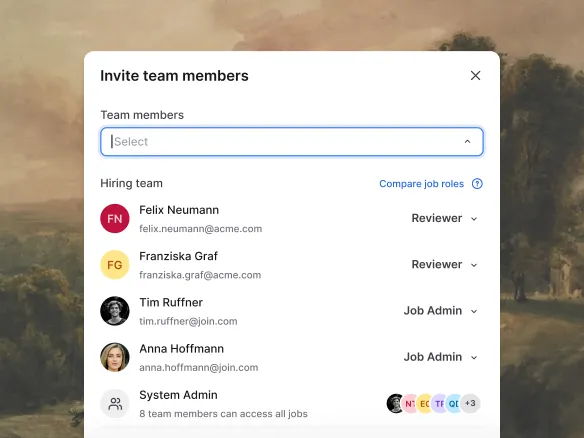
Unless you're a system admin, you only see the jobs and candidates for which you have a job-level role. The marketing team's pipeline isn't visible to engineering, and vice versa. Inviting someone to a role grants them access to that role's candidates; removing them ends it. No global candidate visibility, no accidental cross-team leak.
Users see only the jobs they're explicitly added to
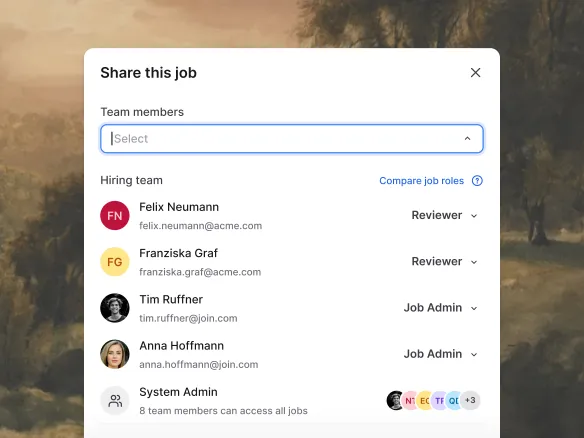
Inviting to a role grants access; removing ends it immediately
No global candidate visibility or accidental cross-team exposure
WHAT YOU CAN DO
A permission model built for real hiring teams.
Two-tier role model
Company-wide role (Admin / Standard / Limited) sets the floor; per-job role (Job admin / Hiring manager / Reviewer) sets what a person can do on each specific role.
Per-job access
Outside of system admins, users see only the jobs and candidates for which they have a job-level role. No cross-team leak by default.
Invite external collaborators to one job
Give an external recruiter or hiring panellist a job-level role on a single role. They never see your other jobs or candidates.
What customers say about Join.Recruiters and hiring managers who use it.
“What used to involve managing multiple platforms, multiple accounts, and multiple invoices now just happens in one place. That's genuinely meaningful when you're running a lean operation.”
Sophie Van SlambrouckInternational Recruitment Manager, AQUALEXRead the story
“Before Join, our recruiting process was scattered and unclear. Now we can publish both blue-collar and white-collar roles from one tool and keep track of every candidate that applies. We actually run hiring the way it should be run.”
Cengizhan AkanRecruiter, Trigon Gruppe GmbHRead the story
“If Join disappeared tomorrow, it would completely blow up our candidate management. We'd have no pipeline and no application flow. We'd have to start over entirely.”
Two axes. At the company level, every user has one of three roles: System admin (full access), Standard (sees only the jobs they're added to), or Limited (most restricted). At the job level, users on a specific role have one of three job roles: Job admin (owns the role), Hiring manager (decides on the hire), or Reviewer (interviews and rates). Outside of system admins, only people with a job-level role on a specific role can see it or its candidates.
Can I restrict access so people only see certain jobs?
Yes. That's the default. Outside of system admins, users can only see jobs where they've been given a job-level role (Job admin, Hiring manager, or Reviewer). The marketing team's jobs aren't visible to engineering and vice versa unless explicitly shared.
How do I give an external collaborator scoped access?
Invite them by email and assign them a job-level role (e.g., Reviewer) on the specific jobs they should work on. They see only those jobs and their candidates, never the rest of your workspace.
How does Join handle authentication?
Join supports email-and-password sign-in plus magic-link auth. Combined with the two-tier role model, that covers access control for SMB hiring teams: company roles set the floor, job roles scope what each person sees.
Where is Join's data hosted and is it covered by processor agreements?
EU data hosting and processor agreements are in place. See trust.join.com for the current compliance documentation.